
Loaded is not verified
How Rate Verification works, end to end. The platform proves a negotiated rate is actually loaded, in the right field, under the right identity, and bookable, instead of trusting that it was.
The core idea
Loaded is not verified.
Loaded is the loader claim: a code was entered into the chain. Verified is the engine proof: the negotiated rate actually returns to an agent, in the correct field, under an authorized identity, at the negotiated value, and is bookable on the dates it should be.
Most loading errors are silent. The code looks entered, but it returns under the wrong field, or a different value, or a squatter property answers, or it is closed on a peak night it was supposed to protect. Each of those is lost revenue or a corporate-audit failure. This platform turns every one into a named, evidenced catch.
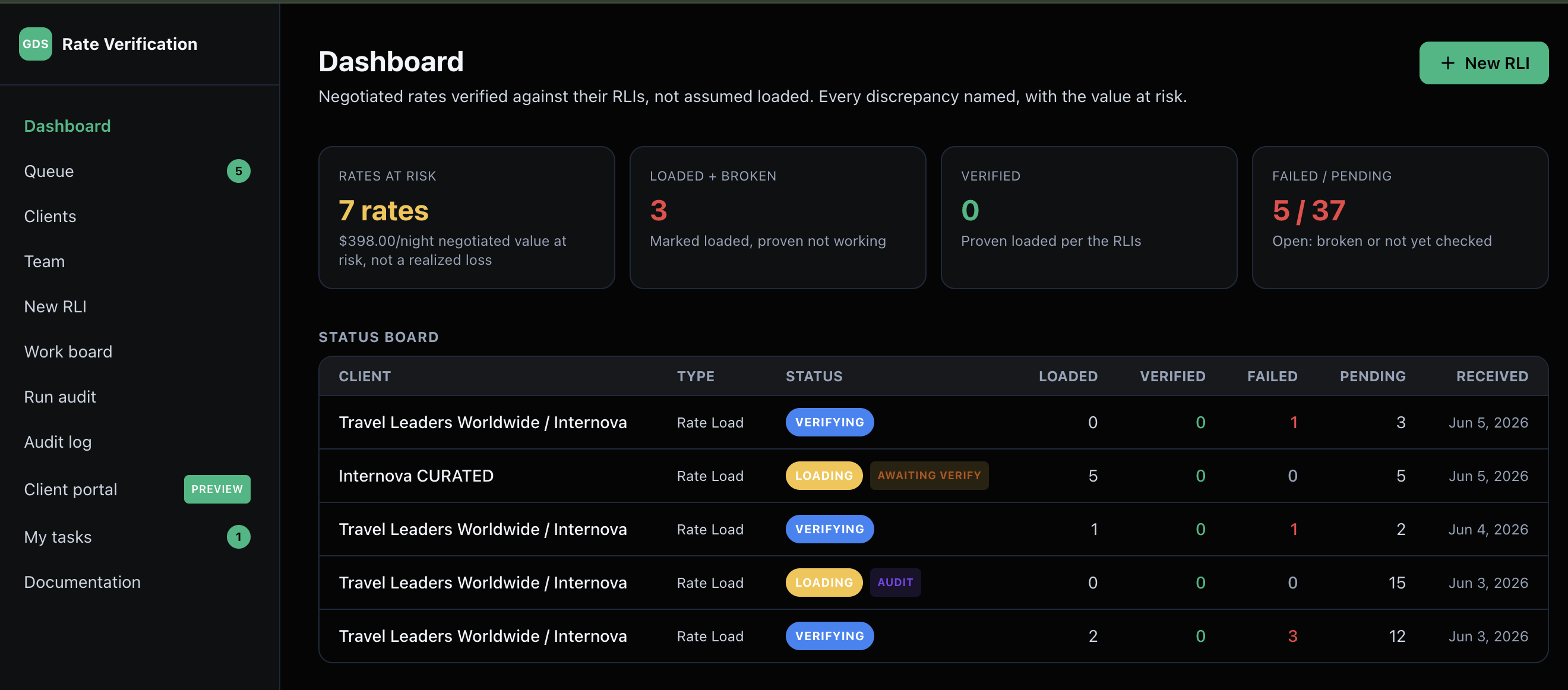
The lifecycle of an instruction
Every RLI moves through these stages.
- 1
RLI received RECEIVED
A Rate Loading Instruction arrives in any format: a branded table, a GBTA master form, an email, or a paste. It enters the queue as the raw record.
- 2
Normalized NORMALIZED
The AI extractor turns the RLI into structured rows, one per property, GDS, and room type. It maps any terminology to canonical fields and never invents codes. Low confidence routes to review.
- 3
Screened SCREENED
Deterministic checks run against the client registry before anyone loads anything. Bad or incomplete instructions are caught here, not after the load.
- 4
Loading LOADING
The instruction is assigned to a loader and loaded into the chain. The platform tracks the assignment but does not auto-commit: loading stays a human, credential-gated step.
- 5
Verifying VERIFYING
A loader pastes the live agent-view screen for a property and GDS. The engine reconciles what actually returned against what was expected and records every discrepancy.
- 6
Complete or Flagged COMPLETE
When every task verifies, the RLI completes. Anything unresolved keeps it open. A screening blocker flags it for human review before it can move.
Type and how it arrives
One type today; two ways an instruction reaches verification.
Every instruction today is Type: Rate Load: a negotiated rate to load and prove. The type field is built to grow, but Rate Load is the only one for now.
It reaches the platform one of two ways. A received instruction is an RLI a client or program sent in, normalized from whatever format it arrived in. An Audit is a self-initiated sweep: a manager runs it, and the engine generates the expected states straight from the client registry to check what is already loaded against the program on file. Audits carry a distinct AUDIT badge wherever they appear.
The registry is the source of truth
Every check compares against the client on file.
Each client carries the authoritative program: its GDS profiles (which code goes in which field for each GDS), authorized booking identities, in-scope properties, canonical room types and their aliases, and the contracted blackout dates. Screening and verification both read from it, so the two always agree. The platform verifies against this profile; it never claims contract authority of its own.
Screening (before the load)
Deterministic checks that catch a bad instruction before anyone loads it.
Verification (after the load)
Paste the live agent-view screen; the engine reconciles what returned against what was expected.
A loader opens the verify panel, picks a property and GDS, and pastes the real screen an agent would see. The engine canonicalizes each returned row, matches it against the expected state, and records a discrepancy for anything that does not line up. It checks the code, the field it sits in, the value, the room type, the identity (name, pseudo city, office ID, chain code), and whether anything is bookable. Re-running recomputes the whole RLI, so the result is always current.
Verification (after the load)
Two dimensions are kept separate on purpose. Load correctness (is the right code in the right place at the right value) always fails when wrong. Bookability (is it open or closed, and why) only grades a load that is otherwise correct. A closed rate never hides a wrong code, and a correct rate that is merely yield-closed is not called a failure.
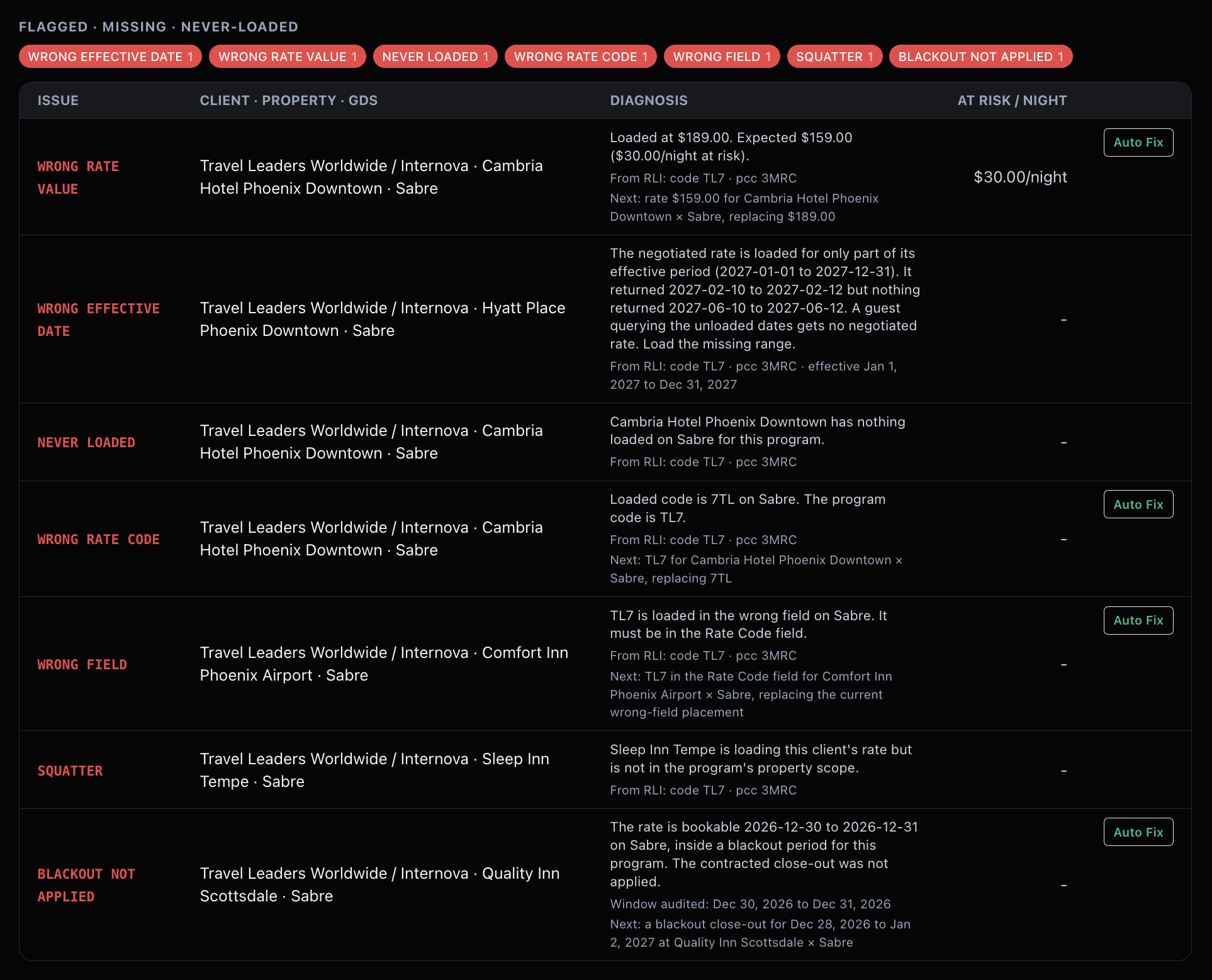
The catches
Every discrepancy the engine can record, and what it means.
Blackout dates
The contractual exception to Last Room Availability, verified in both directions.
Blackout dates are the peak nights a program negotiated to exclude. They are applied as close-outs in the reservation system, separately from the rate-code load, which is exactly where revenue quietly leaks. The platform verifies them two ways:
- Not applied: the negotiated rate is bookable on a contracted blackout date. The close-out is missing. This is a failure (BLACKOUT_NOT_APPLIED) and the Fix button can stage the close-out.
- Correctly closed: a rate closed on a blackout date is expected. The engine never reads that as a failure.
One honest guard: if nothing returns for a window that sits entirely inside a blackout, that is consistent with the close-out, but silence cannot confirm the load was ever done correctly. The task stays PENDING (load-unconfirmed), never falsely VERIFIED and never falsely failed. Verify it from a non-blackout date.
Effective dates and renewals
Verifying the rate is live for the period it was negotiated for, not just present today.
A rate can be loaded at the right value and still be wrong on dates: live for the wrong window, or expired with no renewal behind it. The platform checks the effective period two ways.
- Coverage gap (WRONG_EFFECTIVE_DATE): a loader probes a few stay windows. If the negotiated rate returns for one window but is empty for another window that sits inside the contracted period, the dates it is live for do not match the negotiated period. To avoid a false catch, the proof window must actually contain the negotiated code, and the proof and the empty window must come from the same pseudo city, so a rate released to one office but not another reads as a release gap, not a date gap.
- Expired (EXPIRED): the negotiated period has ended and no renewal supersedes it (a later or open-ended window for the same program would). This is a soft review (NEEDS_RENEWAL), not a hard fail: the rate needs renewing or removing, but it may be loaded perfectly otherwise, so it never reads as a broken load and never as VERIFIED.
Restrictions: LRA and rate parity
The terms that are not printed on an agent-view screen.
Last Room Availability and rate parity are real program requirements, but neither prints on the agent-view screen a loader pastes. LRA is an inventory and sell control; parity is a cross-channel comparison. So the platform does not guess them from the paste. A named person, or a CRS record, attests whether a required restriction was carried onto the load, and only a required restriction attested as dropped produces a finding (DROPPED_RESTRICTION).
The authority of that attestation is graded honestly. A CRS record showing an LRA drop is machine-grade and fails the load. A human attestation of an LRA drop caps the task at UNVERIFIABLE_LRA until a CRS record confirms it, rather than overclaiming a failure. A parity drop always caps at UNVERIFIABLE_PARITY, because true parity can only be proven by cross-channel shopping. The engine records the attested fact; it never invents one, so an attestation can never manufacture a false failure.
Separately, when the negotiated rate is present but closed while other inventory still sells on an LRA program, that confirmed breach is its own catch (LRA_FAIL), read directly from the paste.
Fixing a catch
The platform already computed the correction.
Where a discrepancy has a concrete corrective value (a wrong code, value, field, identity, commission model, or a missing blackout close-out), a Fix button shows the exact change the connected version would stage: the correct value, for that property and GDS, replacing what is loaded. It stages nothing today. Automated write and re-verification needs the enterprise CRS credentials connected. Removals, never-loaded gaps, and attested restrictions are a human call and are not auto-fixable.
What the platform does not do yet
The boundaries, stated plainly. It proves what it can see and routes the rest to a human.
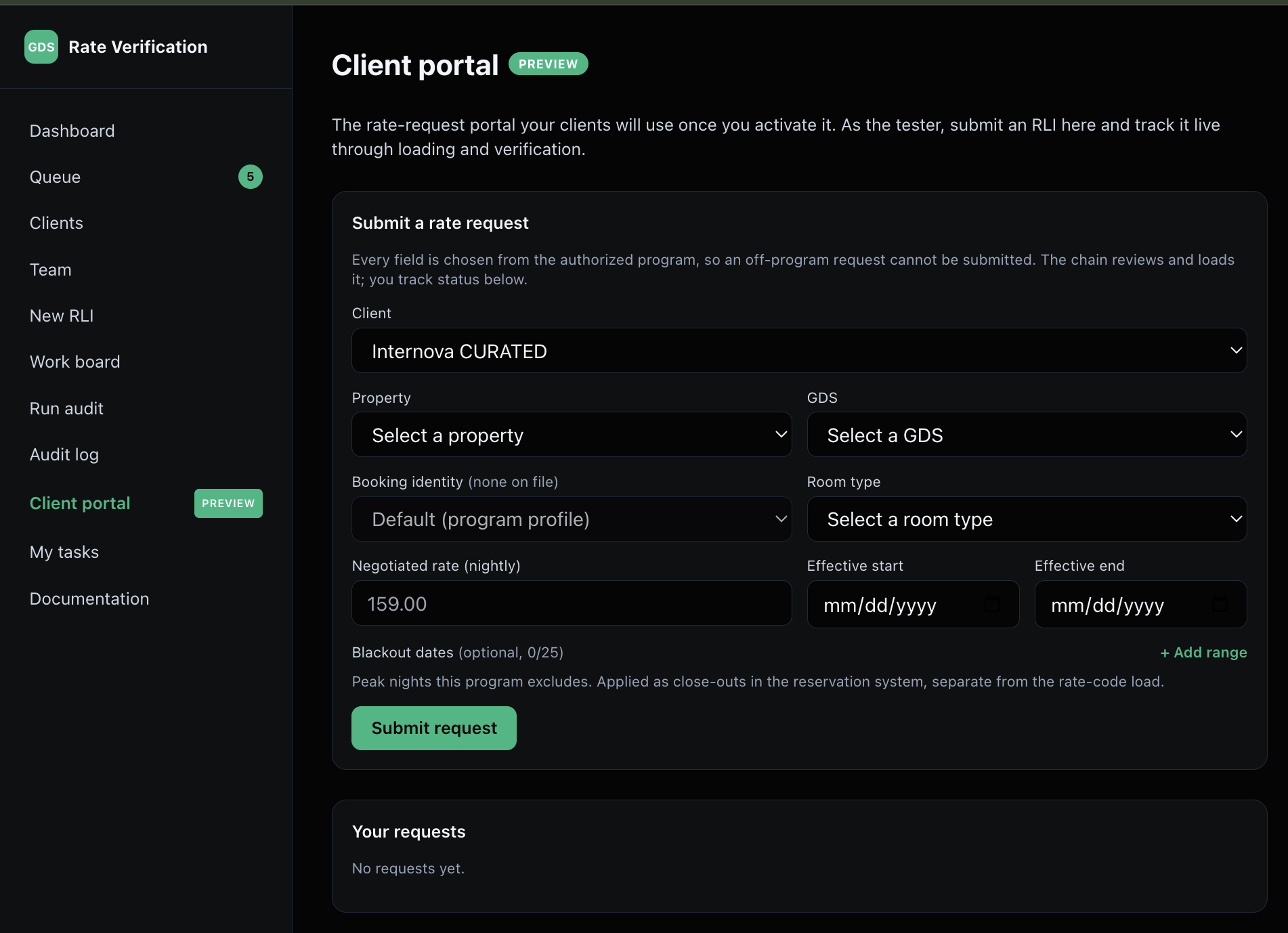
The client portal
Selection-bound rate requests, matched or flagged.
Clients submit rate requests from a form where every field is chosen from their own authorized program, so an off-program request is structurally impossible. Each submission is matched against the client prior loads: an identical request is auto-eligible and enters the normal flow; a changed or new one is flagged for human review. A changed blackout set is treated as inherently suspicious, since contract terms do not normally amend mid-program. The load and commit always stay the chain job, credential and approval gated.
Every action across the vertical is recorded in the immutable audit log, including the AI decision metadata behind each normalization.